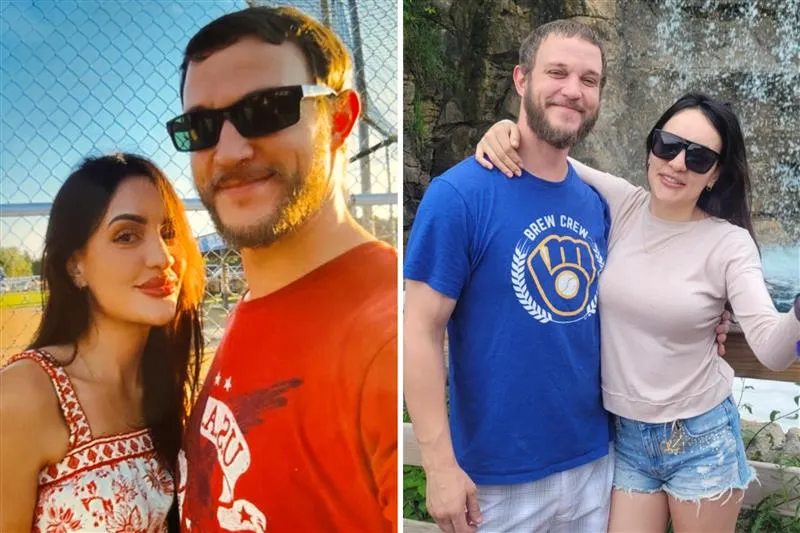
Losing your wife to own the liberals: It sounds like a parody of a Donald Trump voter, but it’s the reality for Bradley Bartell, a Wisconsin man whose wife, Camila Muñoz, is currently detained by Immigration and Customs Enforcement. Muñoz is a Peruvian immigrant who overstayed her visa after being trapped in the U.S. during the pandemic. She met Bartell while working illegally in the country, but because she married an American and is pursuing a green card, the couple believed it would be safe to go on their honeymoon in Puerto Rico. Instead, she was arrested at the airport and is now being held in a Louisiana detention center.
Initially, much of the reaction to the story focused on “regret,” with some outlets suggesting Bartell was “questioning” his vote. But a closer look shows that the story doesn’t indicate he regrets voting for Trump — only that he said, “It doesn’t make any sense.” As Amanda Marcotte pointed out on Bluesky, there is no evidence that Bartell has learned a lesson, and it was predictable that he would continue to stand by Trump.
On Wednesday, Bartell confirmed that prediction, telling Newsweek, “I don’t regret the vote,” while asking for donations via GoFundMe to help cover Muñoz’s bond. He insisted that Trump was not to blame, saying, “He didn’t create the system, but he does have an opportunity to improve it. Hopefully, all this attention will bring to light how broken it is.” In reality, ICE is enforcing Trump’s policies — something his press secretary Karoline Leavitt made clear in January: “If an individual is overstaying their visa, they are therefore an illegal immigrant residing in this country, and they are subject to deportation.”
Bartell’s stance reflects a broader pattern among Trump voters, whose loyalty often outweighs pressing personal concerns. During the pandemic, for example, Republican voters resisted public health measures and rejected vaccines — even ones funded and authorized under Trump — contributing to higher COVID-19 death rates among Republicans compared with Democrats.
Psychological research has long shown that “buyer’s remorse” is difficult for most people to admit, creating rationalizations to avoid saying “I was wrong.” For many Trump supporters, decades of partisan messaging have amplified this effect, portraying liberals as threats and discouraging self-reflection. Personalities drawn to Trumpism often reject critical thinking, favoring “my way or the highway” attitudes that leave little room for dissenting opinions.
Trump and MAGA leaders have also employed tactics familiar from cult studies. The label “Trump derangement syndrome,” applied to anyone criticizing the former president, functions similarly to Scientology’s term “suppressive person,” warning members against engaging with outsiders and fostering dependence on leadership. Conspiracy theories and disinformation reinforce this, while constant messaging fosters an “us vs. them” worldview.
A recent NPR series by Zach Mack detailed his attempts to de-radicalize his father, who had become consumed by MAGA conspiracies predicting mass Democratic arrests and city collapses. Mack’s father lost both his wife and daughter as a result, yet remained consumed with maintaining his sense of superiority over “liberals.” Similarly, Bartell appears more concerned about maintaining his ego than confronting the consequences of his vote.
“I’ve received a lot of hateful messages, plenty of people saying we deserve this. And a lot of other insults,” Bartell said.
Bartell’s comments reveal a focus on personal grievance rather than the real danger: that his vote may have directly endangered his wife. The drive for ego preservation in loyal Trump voters often outweighs practical considerations about family or personal safety.
Rebecca Watson of Skepchick recently emphasized that prior victimization in a scam does not guarantee learning from it. She said, “One of the most obvious ways to know if someone is going to get scammed is knowing that they already got scammed before.” Many radicalized individuals rarely address the root causes that made them vulnerable, and even if they leave one cult or conspiracy, they are likely to adopt another.
There are exceptions, of course. People capable of admitting mistakes tend to be empathetic, self-aware, and curious — traits that often kept them from voting for Trump in the first place. Low-information swing voters, on the other hand, may have voted impulsively and could shift away from Trump without the same ego entanglement. Early approval ratings suggest these voters are already cooling on Trump’s leadership.
Trump has only been in office for a few months, but his support among less committed voters is declining. These individuals are comparable to people who briefly encounter a cult, find it unsettling, and do not return. The focus, analysts say, should be on these more persuadable voters, rather than those fully entrenched in MAGA ideology.