
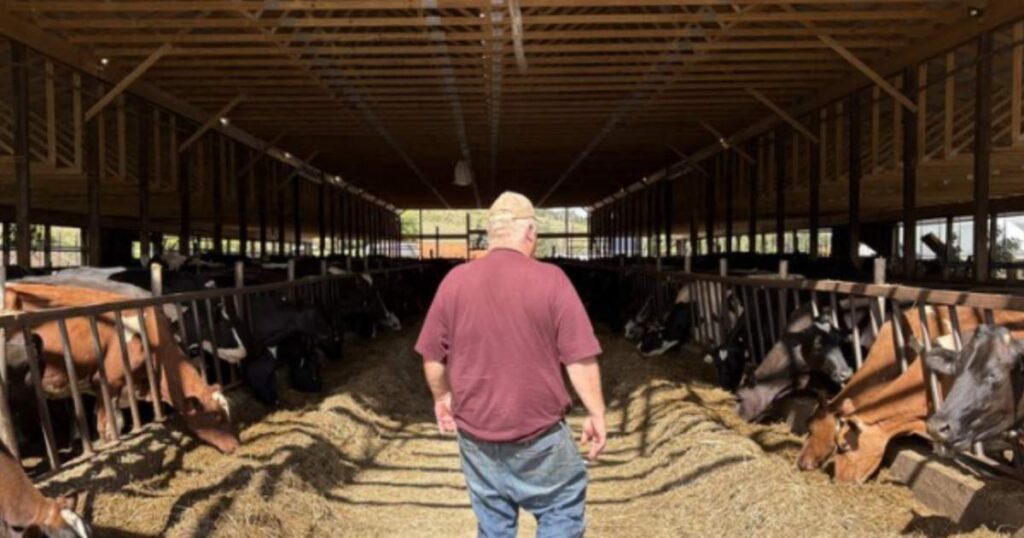
He backed Donald Trump three times, but Pennsylvania dairyman John Painter now says the promise has soured. “The whole thing is screwed up. We need people to do the jobs Americans are too spoiled to do,” the organic milk producer from Westfield said, describing long nights without sleep, vacant milking stalls, and help-wanted notices that go unanswered. His complaint reflects a wider rural backlash as the labor shortage deepens under tighter immigration enforcement and regulatory uncertainty that now also has legal and constitutional implications for farm businesses.
Throughout northern Pennsylvania, growers say they are offloading livestock and leaving crops in the fields because crews have disappeared. Dairy farmer Tim Wood, a member of the Pennsylvania Farm Bureau board, summed it up, “If we don’t get more labor, our cows don’t get milked and our crops don’t get picked.”
The data lines up with what they are seeing. Farm employment dropped roughly 6.5 percent from March to July, reversing the modest increases posted in the same period over the past two years. Meanwhile, estimates indicate the immigrant share of the workforce shrank by more than 750,000 workers between January and June 2025, a sudden pullback that is sending economic shockwaves through agricultural communities and raising questions about labor law, trade policy and constitutional protections for workers.
“The whole thing is screwed up,” said John Painter, a three-time Trump voter who runs an organic dairy farm in Westfield. “We need people to do the jobs Americans are too spoiled to do.”
— Sally Goldenberg (@SallyGold) September 15, 2025
Important story by @sambbenson https://t.co/Yd4xITII7I
On farms, producers link those losses to stepped-up enforcement that has frightened entire crews away. Reports have described raids that left fields idle and produce spoiling, with some farms saying 70 percent of their workers failed to show up afterward. “We don’t have enough workforce in the United States to do the manual work,” one advocate warned, forecasting rising food prices and farm closures if the situation continues.
Trapped in the middle, House Agriculture Committee Chair Glenn “G.T.” Thompson, the Republican whose large district includes many of the affected dairies, says he plans to introduce legislation to steady the workforce. Thompson is drafting a bill to overhaul the H-2A visa system so farms can count on a consistent supply of workers, and he has argued that without a dependable labor force, food security and national security are both at risk — a view now echoed by legal scholars and trade analysts.
Policy experts and farm groups want lawmakers to go further by finally allowing year-round businesses like dairies to use guest workers legally. At present, H-2A is mostly limited to seasonal jobs, which leaves dairy out. A recent proposal would set up a capped pool of year-round H-2A visas, with a large portion initially set aside for dairy, and provide status for long-time agricultural employees so they can keep working without constant fear of removal, a change supporters say would reduce litigation and compliance costs.
The White House says it is listening. Agriculture Secretary Brooke Rollins said President Trump is reviewing every available option to address farm labor while acknowledging that Congress must deliver lasting solutions. The administration has floated ideas such as a touchback process or adjustments to the H-2A program, even as immigration hardliners push back and promise no amnesty. For farmers, that political standoff does not milk a single cow or resolve the legal uncertainty hanging over their payrolls.
So Painter waits. The herd still needs tending twice a day. The fields still need hands. And the political reality he once supported now feels like a weight on his operation.
“They want the American dream, and they want to work,” he says of the migrant crews who once kept his dairy running. With labor drying up, exports unsteady, and prices edging higher, he and his neighbors are pleading with Washington for one thing they can plan around: certainty. And they want it fast. It remains to be seen how Trump’s tariffs and immigration policies will reshape the outlook for farmers across the country.