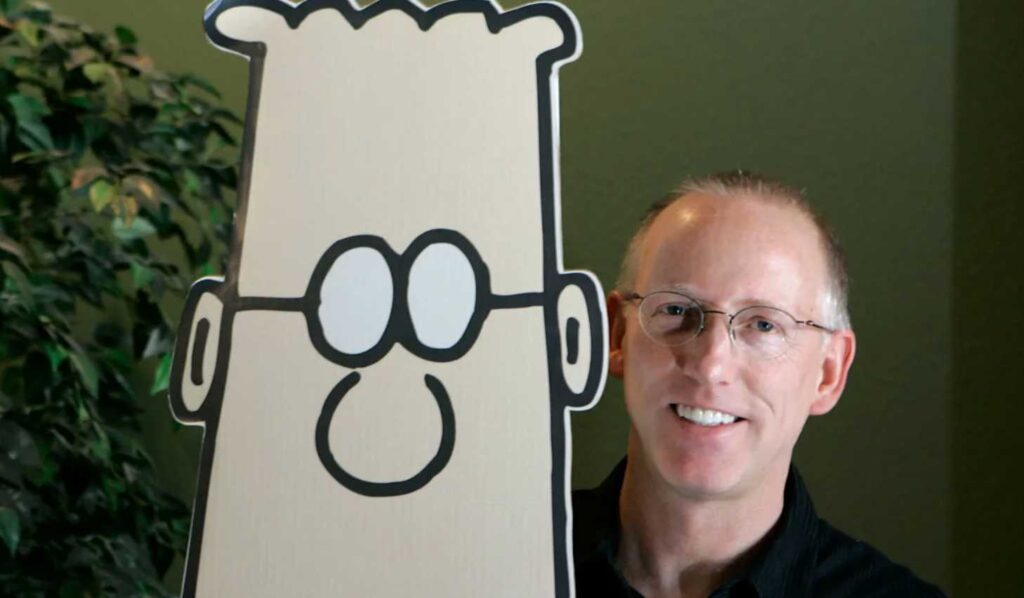
Scott Adams, the creator of the once-ubiquitous “Dilbert” comic strip and a vocal supporter of President Donald Trump, died Tuesday at 68 after battling metastatic prostate cancer — a death that has become a stark symbol of the contradictions between Trump-era political loyalty and the realities of American healthcare.
Adams’ former wife, Shelly Miles, announced his death in a livestream, reading what she said was a final message from the cartoonist. Adams had revealed his diagnosis in May 2025 on his “Coffee with Scott Adams” show, telling viewers he had only months to live.
In the final phase of his illness, Adams turned not to the healthcare system he had spent years attacking, but to Donald Trump himself. He publicly pleaded for help after saying his provider, Kaiser Permanente of Northern California, had not scheduled treatment with the targeted radiotherapy drug Pluvicto. Trump responded publicly on November 2, writing: “On it.” Adams then posted the following day that he would begin receiving Pluvicto immediately.
After Adams’ death, Trump returned to social media to mourn the cartoonist. “Sadly, the Great Influencer, Scott Adams, has passed away. He was a fantastic guy, who liked and respected me when it wasn’t fashionable to do so. He bravely fought a long battle against a terrible disease,” the president wrote on Truth Social.
For many observers, the episode captured the strange inversion of Trump-era politics: a wealthy conservative who spent years attacking government healthcare ultimately relying on political intervention to get access to lifesaving treatment. Long before his illness, Adams had publicly opposed programs like Medicare and the Affordable Care Act, arguing they were “entitlements” that should be cut or abolished.
Despite his personal wealth and influence, Adams had also promoted alternative medicine and anti-pharmaceutical ideas, including rejecting standard treatments in favor of fringe remedies. By the time he turned to conventional medicine, his cancer had progressed to a terminal stage, leaving him dependent on a drug that required special authorization.
Adams’ political identity had already overshadowed his professional legacy. While “Dilbert” was first published in 1989 and became one of the most widely syndicated comic strips in America, dozens of newspapers dropped it in 2023 after Adams posted a racist rant on YouTube. In it, Adams called Black Americans a “hate group” and suggested white Americans should “get the hell away from Black people.”
Adams later claimed the remarks were hyperbolic and said he disavowed racism, but billionaire Elon Musk publicly defended him, accusing the media of bias against whites and Asians. The episode permanently altered how Adams was seen, shifting him from workplace satirist to culture-war provocateur.
In the end, however, it was not cancel culture or media criticism that defined Adams’ final months — it was the brutal reality of healthcare in a system he had spent years trying to dismantle. While millions of Americans face long waits, denials, or crushing costs for cancer treatment, Adams was able to appeal directly to the president of the United States to speed up his care.
The irony was impossible to miss. A man who argued that healthcare should not be a guaranteed public good ultimately relied on political power and personal connections to access cutting-edge medicine.
As Trump once again made Adams’ death about loyalty, praising him for having “liked and respected me when it wasn’t fashionable to do so,” critics saw a final, bitter confirmation of what many Trump-era conservatives have learned the hard way: public systems are only dispensable until you need them yourself.