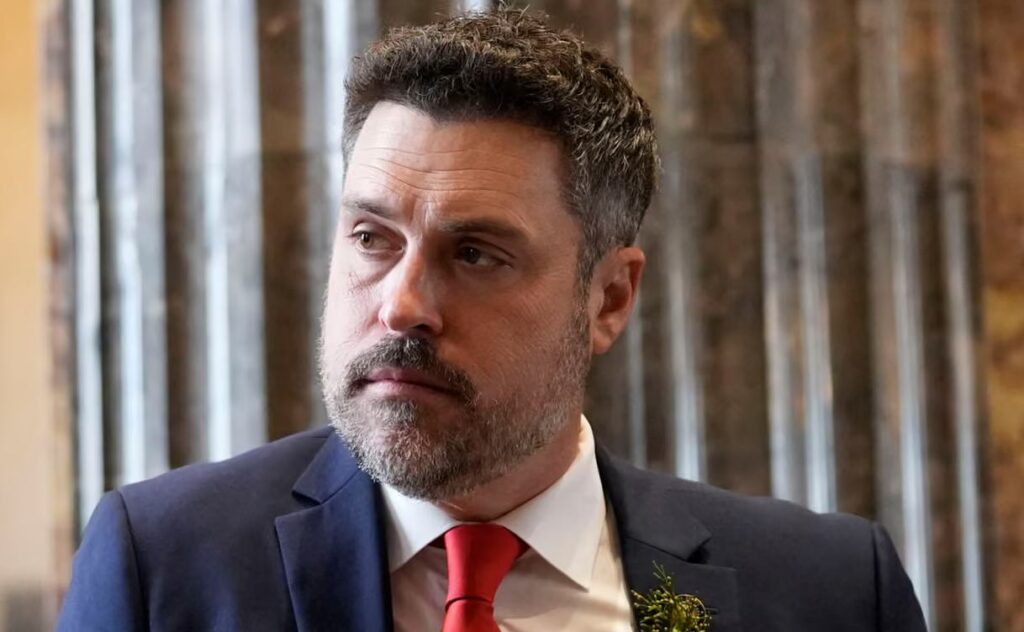
A Louisiana congressional candidate endorsed by President Donald Trump is facing renewed scrutiny after a 2007 rape accusation surfaced that had been reported to local law enforcement the same day of the alleged assault but was never made public as he rose through the state’s Republican political ranks. The allegation involves Blake Miguez, a Louisiana state senator who has become a prominent figure in the state’s GOP and is now running for Congress.
According to a report published Wednesday by the Atlantic, concerns have emerged within the White House about whether Miguez was properly vetted before Trump offered his endorsement. The outlet, citing two unnamed sources familiar with the endorsement process, reported that officials were worried Miguez “either wasn’t fully vetted or wasn’t forthcoming about discoverable documents from his past.”
Miguez’s campaign responded Thursday with a statement rejecting the allegation made by a woman who described him as a “live-in ex boyfriend” at the time. The campaign called the claims categorically false. The accusation did not lead to criminal charges after the woman reportedly declined to pursue the case. Investigators noted in a police report obtained by the Guardian through a public records request in February that the accuser said she did not want to press charges because she did not want Miguez—who was then attending law school—to get into trouble. Efforts to reach the woman for comment were unsuccessful, and there is no indication that she later withdrew the allegation.
In its statement, the Miguez campaign also pointed to reporting by a Louisiana news outlet that followed the Atlantic and Guardian coverage. That report included comments from relatives of the accuser, who suggested she had struggled with mental health issues and said they therefore “seriously doubt her allegation against Miguez.” Earlier in March, Miguez’s campaign responded to questions from the Guardian by providing a 24 February email sent by the accuser’s father to the state senator’s office. The email included the line: “Everything my daughter has reported about you were lies and she is a liar and has a drug problem.” The message does not explain how the father concluded his daughter had lied, and he did not respond to a request for comment. Miguez’s campaign said in a statement: “The woman’s father gave permission to share this email with you.”
NEW: Trump endorsed Blake Miguez for a Louisiana House seat last month. But no one told the White House that Miguez's former girlfriend had filed a 2007 police report accusing him of rape. Miguez denies, and she asked not to press charges. GIFT LINK: https://t.co/lhbnNU2Cli
— Michael Scherer (@michaelscherer) March 11, 2026
The police report documenting the allegation had been circulating quietly within political circles for months as Miguez, now 44, prepared to pursue higher office. In late June, the Iberia Parish sheriff’s office received a public records request that produced the report containing the 2007 allegation. The request was filed six days after Miguez announced plans to challenge Louisiana’s senior U.S. senator, Republican Bill Cassidy. The request originated from an email account linked to a man whose name matched that of a researcher affiliated with the national Republican Party. Word of the document began spreading through political and government circles before eventually reaching media outlets across the political spectrum.
Miguez abandoned his Senate challenge against Cassidy on 3 February and instead entered the race for Louisiana’s fifth congressional district. That seat is being vacated by Republican Representative Julia Letlow, another Trump-backed candidate who is now running against Cassidy. On 27 February, conservative Washington journalist Matthew Foldi was the first to publish details about the allegation against Miguez. His report focused heavily on the accuser’s father siding with Miguez and offering his “100% support” in the February email, which was reportedly sent shortly after the father was contacted by an Associated Press journalist.
The email explained that the father declined to read the police report when it was offered to him and said neither he nor other relatives would “speak with these people.” It also reassured Miguez: “You have my vote” and: “We are there for you.” Foldi’s article also questioned the accuser’s credibility and highlighted her history of arrests. Those details appear to echo information obtained through a public records request filed by a Baton Rouge private investigative firm in September. Documents reviewed by the Guardian show the records relate to misdemeanor and felony allegations involving the accuser, including charges tied to drug possession. Most of those cases were dismissed, while two remained pending in a local criminal court as of Wednesday.
The report also referenced court records indicating the woman had previously accused other romantic partners of assault and sought protective orders against them. According to the records cited, those cases were later dropped or dismissed. Those incidents occurred years after the woman reported the allegation against Miguez. The Guardian has not identified the accuser, following its newsroom policy of not naming alleged victims of violent crimes without their consent.
Miguez secured high-profile endorsements from Trump and the conservative advocacy group Club for Growth in mid-February ahead of the Republican primary scheduled for 16 May in the reliably GOP district. Trump representatives did not immediately respond to questions from the Guardian about whether the president still supports Miguez following the reports. A spokesperson for Club for Growth defended the endorsement, stating: “We are aware of the false accusations made 20 years ago and do not find them credible because of the accuser’s long record of false claims and criminal history including similar dismissed allegations against five others.” The spokesperson did not say whether Miguez disclosed the 2007 police report to the group before it issued its endorsement.
According to the police report, the incident was first reported on 27 August 2007, when the woman contacted the Iberia Parish sheriff’s office and alleged that the man she described as her live-in ex raped her following a night of drinking. The report states that both she and Miguez returned to their apartment in Erath and argued after she spoke to another man earlier that evening. The woman said she eventually went to bed and that Miguez raped her. The report further states that she ran to a nearby convenience store, contacted a friend for help, and called deputies to report the incident.
Deputies later “detained” Miguez for questioning and brought him to the sheriff’s office, though the report does not specify whether he made statements to investigators at the time. Investigators also wrote that the woman told them she “did not want Blake to get into trouble, but she wanted him to understand that he is not to disrespect her like he did”. The woman later went to a hospital accompanied by a friend and a deputy to undergo a rape kit examination. While at the hospital, she again stated she did not wish to press charges, investigators noted. The report adds that she ultimately “refused any and all medical treatment from the hospital.”
Miguez later served more than eight years in Louisiana’s House of Representatives before winning election to the state Senate in 2023. Known as a champion competitive sharpshooter, he sponsored a bill in the state Senate lowering the minimum age for carrying a concealed weapon in Louisiana from 21 to 18. The measure passed the legislature and was signed into law by Governor Jeff Landry, a staunch Trump ally. Miguez also drew attention for his role on a politically charged Louisiana Senate committee examining criminal justice reforms in New Orleans, a Democratic stronghold within the largely Republican state.
According to the Louisiana outlet nola.com, Miguez originally planned to challenge Cassidy for his Senate seat, positioning himself as a strong supporter of Trump’s Maga movement and arguing that Cassidy had diverged from that agenda in several instances. However, after Letlow entered the Senate race with Trump’s backing, Miguez withdrew from that contest and instead filed to run for the congressional seat she was leaving behind.
Trump quickly endorsed Miguez afterward, describing him in a 4 February social media post as a “Maga warrior”. “HE WILL NOT LET YOU DOWN!” the president’s endorsement message also said. Club for Growth issued its endorsement a day earlier, describing Miguez as “a conservative fighter” and “the perfect candidate” to represent Louisiana’s fifth congressional district.
Miguez continues to live in Erath, which is located outside the boundaries of the district he is seeking to represent. Under federal law, congressional candidates do not have to reside within the specific district they seek to represent, provided they live in the same state. Miguez’s campaign says he has maintained a residence within the fifth district for roughly 26 years and has operated a business in Baton Rouge, which lies inside the district, for more than a decade. Meanwhile, one of Miguez’s fellow Republican senators in Louisiana recently introduced a non-binding resolution urging Congress to require U.S. House candidates to live in the districts they aim to represent.
Public reactions to Miguez’s resurfaced 2007 allegation have been swift and pointed on social media, with many users expressing outrage at Trump’s endorsement. Comments include: “Well, duh. That’s one of the requirements on Trump’s checklist of people he endorses,” and, “He’ll fit right in then. Why else would Dumps endorse him?” Others were even more direct, questioning the broader implications of backing a candidate with a sexual assault allegation: “A sex offender? That’s a great way to wind up in the highest office.” These reactions highlight the growing public scrutiny and skepticism surrounding both Miguez’s candidacy and Trump’s decision to support him.