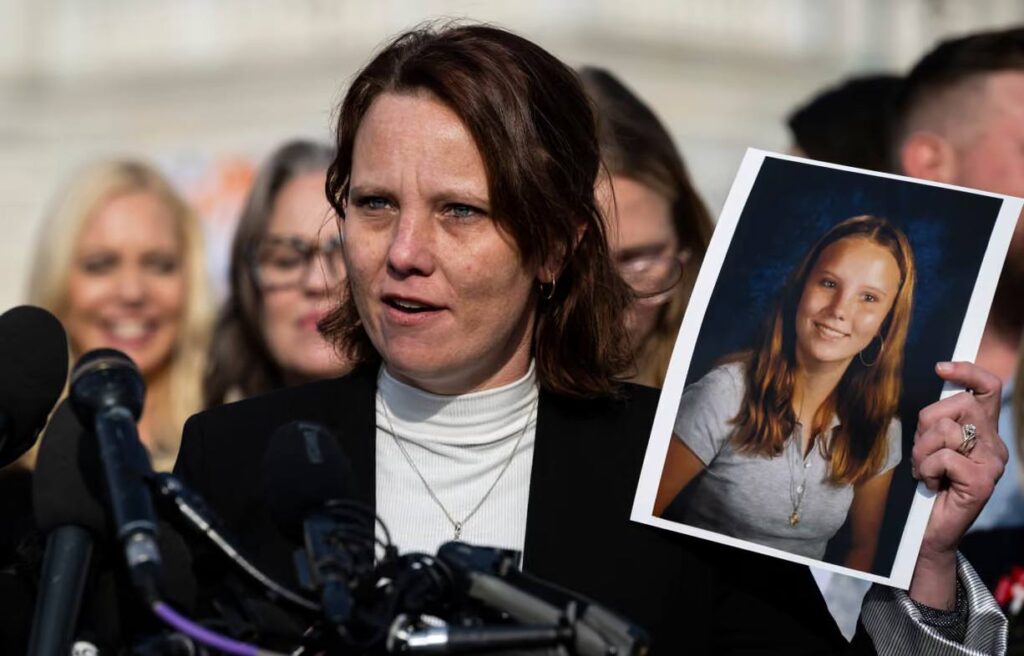
After casting her ballot for Donald Trump in 2024 with hopes he would bring transparency to the Jeffrey Epstein case, Epstein survivor Jena Lisa Jones said in an interview this week that she now fears “we’re not going to get justice in all of this”.
“I wanted my day in court,” said Jones, who has said she was abused by Epstein when she was 14, in an interview on the Shadow Sessions podcast that aired on Thursday morning. “I didn’t get that, and we were so close to it, it really got ripped from us, and then after [Epstein] passed, everything just went into a circus show.”
Jones said she supported Trump in the 2024 election largely because of his promises to release files connected to Epstein – who died in jail in 2019 while awaiting trial on federal sex-trafficking charges involving minors – and his broader network.
“Trump ran his whole freakin’ election on the release of these freakin’ files,” she said. “And it sparked it back all up again, gave us hope, gave me hope at least.
“He runs his campaign on this, and he runs it really, really hard to the point that a lot of us voted for him,” she added.
However, after the election, Jones said her outlook quickly changed. “As soon as he gets in, we started pushing for the release of the files, and now it’s a ‘Democratic hoax’,” she said, referring to remarks Trump made in the fall dismissing calls to release additional Epstein files as a Democratic “hoax”.
Over the summer, the administration faced backlash after the justice department announced it would not release further Epstein-related files, despite Trump’s campaign pledges.
When asked what justice would look like, Jones said: “For me now, is America taking the predators that are here in our country, yes, take them down in every country, but I would like to see some of that, that would give me a little bit more faith and that we’re doing the right thing and that we’re protecting our children.”
Later in the interview, Jones described the backlash she and other survivors have encountered for speaking publicly.
“When you do speak out, they eat you alive – you have a lot of support, but you also have a lot of crazy people that are out there,” she said, adding that she has received “death threats for speaking out”.
Despite that, Jones said she remains determined to continue telling her story and demanding accountability.
“Every time I share my story, and a young girl reaches out to me, sends me artwork she’s made, writes me a letter, tells me how important it is that I’m fighting and speaking out, [it] reminds me every freakin’ day exactly why I’m doing this, and will not stop doing this, even after I get whatever justice looks like for me in my case,” she said.
Toward the end of the interview, the interviewer asked Jones what one thing she feared was. Jones responds: “That we’re not going to get justice in all of this and take down the bad people.”
In November, Jones was among a group of Epstein survivors who gathered outside the US Capitol urging lawmakers to pass legislation requiring the justice department to release records related to Epstein. At that news conference, she called on Trump to “stop making this political”.
“I voted for you, but your behavior on this issue has been a national embarrassment,” Jones said in her speech.
It came as Trump had, for months, opposed the congressional bill mandating the release of justice department Epstein files, before reversing course when it became clear it had enough bipartisan support to pass. He signed the bill into law on 19 November.
Trump has consistently denied any wrongdoing related to Epstein or any knowledge of his criminal activity.
Since November, after the bill was signed into law, the Department of Justice has released multiple batches of records, including a disclosure of roughly 3 million documents in January. While the releases have provided additional insight into Epstein, his network and the investigations surrounding him, some lawmakers and survivors argue that key materials are still missing.
Several survivors have said that files documenting their own FBI interviews were not included in the releases, while some lawmakers have accused the justice department of withholding and heavily redacting material in violation of the law, raising concerns that some disclosures exposed personal information about survivors.
The justice department has said that “ALL responsive documents have been produced unless a document falls within one of the following categories: duplicates, privileged, or part of an ongoing federal investigation”.
In the podcast interview that aired on Thursday, Jones said she has yet to locate her files among the released records. “I haven’t seen my files in there, and I know that they have files, because I did speak with the FBI,” she said. “I did work with the FBI. I mean, I texted the FBI the day he died.”