
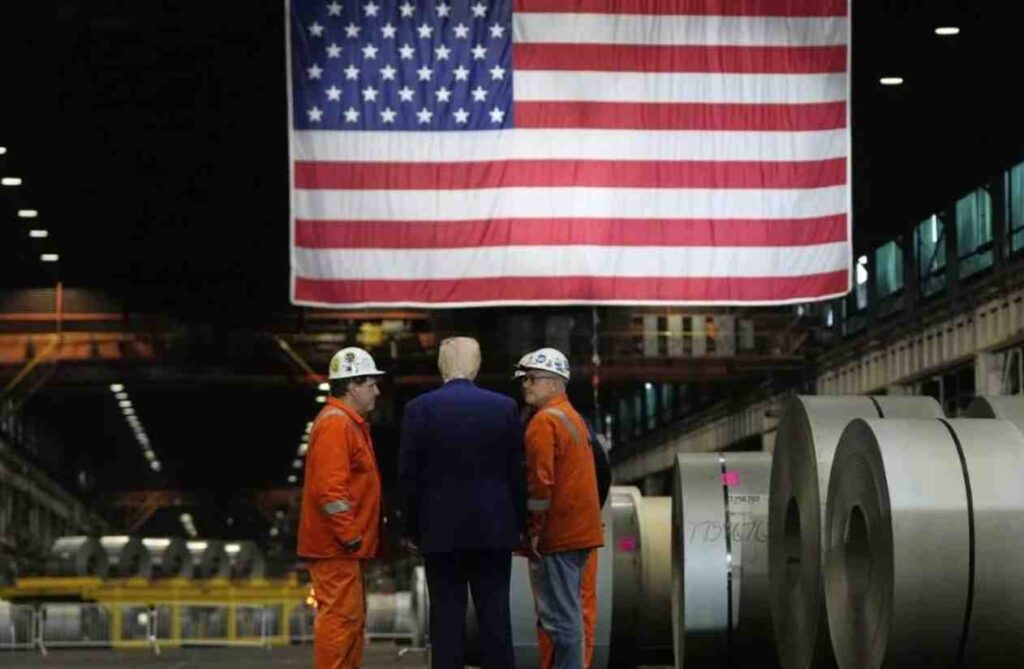
As President Donald Trump gets ready to unveil another round of tariff hikes, manufacturers across the country are already bracing for the financial shock. For people like Josh Smith, founder of Montana Knife Co., the consequences are not theoretical—they’ve already hit his bottom line. Smith recently invested in a $515,000 blade-grinding machine from Germany, and thanks to Trump’s updated trade rules, that purchase now comes with an additional $77,250 in taxes at the border.
The administration is implementing tariffs between 15% and 50% on products from dozens of nations, including the European Union, Japan, and the UK. Although the White House insists these measures will revive U.S. factory work and shrink the budget deficit, many American manufacturers warn that these steep costs could slow raises, force layoffs, or even push some facilities into closure.
Chris Bangert-Drowns of the Washington Center for Equitable Growth estimates that production costs could jump 2% to 4.5% because of the tariffs. “That might seem minor, but for businesses operating on thin profit margins, it could mean wage stagnation or plant shutdowns,” Bangert-Drowns said.
Trump is betting that he can frame these tariffs as a sign of American economic muscle, but the real question is whether factory towns will feel any revival—and whether ordinary workers will experience more stability.
For Smith, the dilemma is straightforward and maddening. “I would love to buy American-made grinding machines, but they don’t exist,” he said. “Only two companies in the world make them, and both are in Germany.” The new 15% tariff alone, he said, is the equivalent of what he would have spent hiring a new employee.
His struggle mirrors problems emerging throughout the U.S. industrial sector. Trump has set a 50% tariff on imported steel and aluminum, giving American metal producers room to push prices higher. Justin Johnson, president of Jordan Manufacturing Co. in Michigan, says that steel coil costs have risen 5% to 10% this year. “There’s no capitalist who wouldn’t raise prices when competition is crippled,” Johnson said.
Even as Trump insists tariffs are not contributing to inflation, business owners tell a different story. A recent Atlanta Federal Reserve survey shows most companies expect to pass at least half of their tariff-related costs onto consumers. Meanwhile, Labor Department data indicates the U.S. shed 14,000 manufacturing jobs after Trump rolled out his first series of tariff hikes in April.
In key battleground states like Michigan and Wisconsin, over 20% of workers hold jobs in sectors heavily exposed to these tariffs—manufacturing, construction, mining, and oil drilling. Even industries Trump has promoted as America’s next frontier, such as artificial intelligence and advanced electronics, rely heavily on imported parts, with more than one-fifth sourced from abroad.
The White House maintains that its trade strategy will strengthen opportunities for U.S. firms and revive the prestige of domestic goods. “Under President Trump, ‘Made in USA’ is set to resume its global dominance,” spokesman Kush Desai said.
Still, the full picture remains uncertain. Treasury Secretary Scott Bessent recently suggested that other countries are willing to absorb the hit of the tariffs to keep access to the American consumer market. Yet American manufacturers are paying that price as well, and many report they’re already feeling squeezed.
Smith, who voted for Trump, says it’s bitterly ironic that policies meant to strengthen American industry are increasing the pressure on small and mid-sized manufacturers. After Crucible Industries—a major U.S. steel supplier—filed for bankruptcy, Smith was forced to buy his specialty steel from Sweden, a country that will soon face a 50% import tariff of its own starting in 2026.
To soften the immediate blow, Smith stocked up on a year’s worth of steel in advance. Even so, he is worried about how sustainable his business can be if the tariff regime continues to expand. “I’m sitting here looking at numbers every day, deciding whether we can hire more people or invest in more equipment,” Smith said. “These tariffs make those decisions harder.”
Trump continues to argue that tariffs will rebuild American manufacturing without pushing prices higher, but economists like Ernie Tedeschi of Yale University challenge that claim. Tedeschi estimates that U.S. households could lose as much as $2,400 a year from tariff-driven price increases.
As the administration presses ahead with its new trade agenda, companies like Montana Knife Co. find themselves stuck—trying to grow, innovate, and hire while preparing for yet another round of escalating costs.


What a liberal with TDS!!! This man might as well just say he’s in a romantic relationship with Obama because he’s clearly trans in his way of thinking this is Trump’s fault. This has Hillary written all over it! Don’t believe these lying dems pretending to be conservatives. They only want to trick and destroy us.
Wow amazing blog layout How long have you been blogging for you made blogging look easy The overall look of your web site is magnificent as well as the content
Oh my God, how could Obama do this to us?