
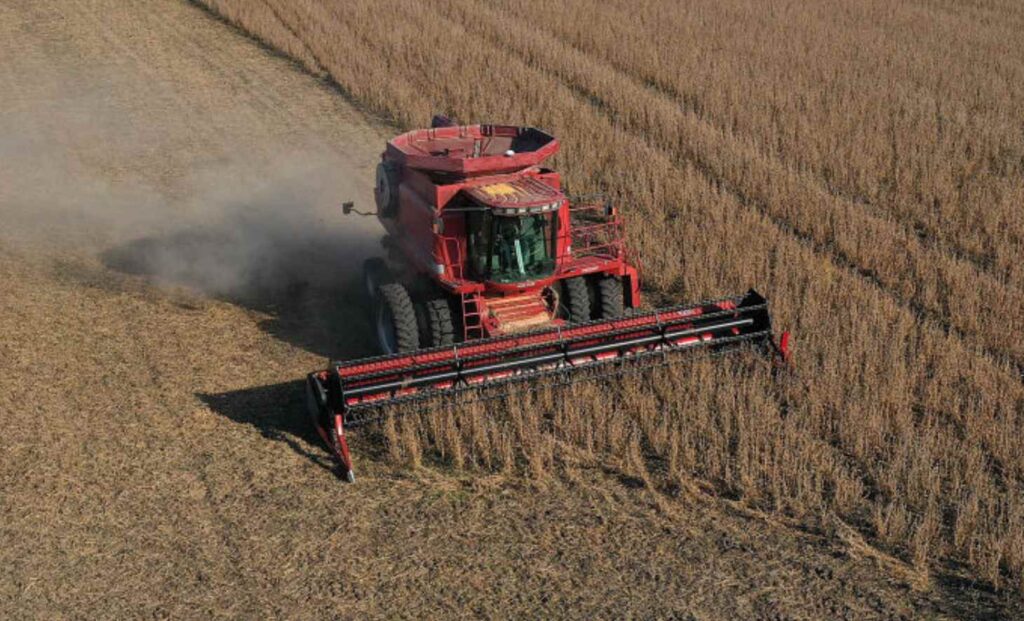
Along with other pressures, President Donald Trump’s sweeping tariffs on Chinese imports are inflicting significant losses on Ohio farmers and their peers nationwide, according to a newly released analysis.
The report indicates that Ohio farmers have seen exports to China fall by nearly $76 million this year compared with the same period a year earlier.
Tariffs are taxes placed on imports, and since the beginning of his second term, Trump has rolled out an evolving set of them on virtually every country in the world — with Russia notably excluded — according to the Atlantic Council’s Tariff Tracker.
Economists have warned that the constantly changing trade measures have dampened some business investment, as companies struggle to plan amid uncertainty. Surveys by the Federal Reserve Bank of Cleveland also show that businesses across the region are absorbing higher input costs tied to tariffs, with many passing those increases on to consumers.
That dynamic comes as Republicans grapple with a broader affordability crunch.
Farmers, meanwhile, are being hit from two directions. Many of their production costs have climbed because of import taxes.
At the same time, China — the United States’ third-largest trading partner — halted purchases of American soybeans in May before resuming them last month. The pause came in retaliation for Trump’s tariffs, which now stand at 20%, according to the tariff tracker.
That disruption could have long-term consequences for Ohio soybean growers by accelerating China’s efforts to deepen and lock in trade relationships with Brazil, another major agricultural exporter.
Trump has also imposed 50% tariffs on the South American nation in response to its imprisonment of an authoritarian former president who attempted a coup.
Ohio farmers are already feeling the fallout.
Stable trade ties with China had been shaken during Trump’s first term as well, according to Farm Flavor, an agriculture-focused media outlet.
“Over the past decade, the flow of American agricultural goods to China has shifted from reliable seasonality to stark volatility,” the outlet said in a report released Tuesday.
“From 2014 to 2017, exports followed a predictable rhythm throughout the year, peaking each fall with the soybean harvest. That pattern broke with the onset of the 2018 trade war, then rebounded sharply in 2020 and 2021 after the Phase One trade agreement. With Chinese purchasing commitments in place, monthly exports hit record highs in late 2020 and remained elevated through 2022 – fueling optimism that the relationship had stabilized.”
That outlook dimmed in 2023, when Brazil posted record soybean and corn harvests, undercutting prices sought by U.S. producers. In the aftermath of the first Trump trade war, China also moved to “de-risk” its agricultural supply chain by strengthening trade with South America, the report said. “By 2025, these forces — combined with a renewed trade war — converged into a full collapse,” it said.
“After steady declines in 2024, U.S. agricultural exports to China fell by more than half in the first eight months of 2025. The low point came in May, when monthly exports dropped to just $247 million – the lowest level in over a decade.”
Reviewing U.S. Department of Agriculture export data, Farm Flavor found that Ohio ranked as the 13th most affected state, with farmers losing nearly three-quarters — about $76 million — of their exports to China compared with a year earlier. Ohio soybean growers took the biggest hit, with exports to China down 85%.
Six of the 10 states hardest hit supported Trump in last year’s election, and the administration may be starting to feel the political pressure. Last Tuesday, the president announced a $12 billion bailout for the agricultural sector.
Critics, however, questioned whether a one-time payment could offset losses that appear structural and already far exceed the size of the aid package.
Agricultural trade with China alone is down $17 billion this year compared with last — a figure that is 42% larger than the total bailout.
Across nearly all categories, U.S. agricultural exports to China have dropped sharply this year from their 2024 levels, based on USDA data compiled by Farm Flavor. A snapshot, ranked by total volume, shows:
- Soybeans — 53%
- Cotton — 89%
- Beef — 54%
- Pork — 20%
- Wheat — 100%
- Tree nuts — 88%
- Dairy products — 2%
- Corn — 99%
- Hides and skins — 34%