
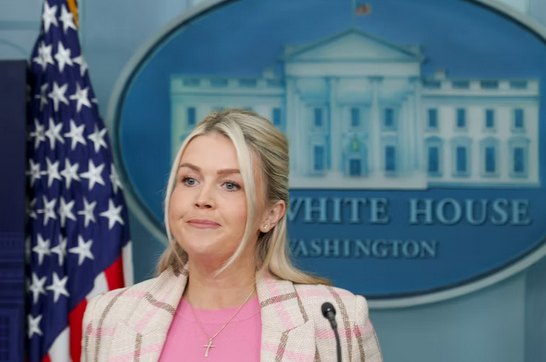
Married women could be required to update their identification documents in order to vote if the SAVE America Act is approved by Congress, according to comments made by White House press secretary Karoline Leavitt.
Answering a reporter’s question Tuesday during a White House briefing, Leavitt initially argued that the legislation would not block married women from casting ballots. Moments later, however, she acknowledged that the measure would require married women and other voters who have changed their names to re-register before participating in elections.
“The Democrats have created this myth.… Let me be very clear: The SAVE America Act does not prohibit anyone from voting, with the exception of illegal aliens,” Leavitt said. “As far as married women who have changed their name, if they’ve already registered to vote, they’re entirely unaffected by the SAVE Act. For the small fraction of individuals who have changed their name or their address, they can still register to vote, of course. They just have to go through their state processes to update that documentation.
“This is something that the American people, married women, and minorities—people all across this country who the Democrats are insultingly saying cannot do this—they’re already doing it every day. Going to the Social Security office, going to the DMV. I think it’s frankly insulting,” Leavitt said.
The SAVE America Act proposes multiple changes to the National Voter Registration Act of 1993. Among the provisions are measures that would eliminate mail-in voting, require voters to present proof of citizenship and proof of residency when registering, mandate voter identification, and require voter roll purges every 30 days — a sweeping bureaucratic undertaking that critics say would place heavy burdens on local election officials.
“This is popular and rooted in common sense,” Leavitt said while describing the proposed revisions, repeatedly characterizing the changes as “simple.”
The legislation also includes provisions that go beyond election procedures. The bill would add federal rules aimed at preventing men from competing in women’s sports and introduce a ban on what the proposal describes as “transgender mutilation surgery.”
“Passing the SAVE America Act is the most important thing that Republicans and, frankly, Democrats can do to strengthen election integrity and protect our democracy,” Leavitt insisted.
Despite that claim, the SAVE Act has faced substantial resistance. An earlier Republican attempt to pass the legislation collapsed in late 2025 amid widespread nationwide opposition. Previous versions of the proposal included requirements that voters present proof of citizenship each time they cast a ballot, although that specific provision has since been removed from the revised bill.
Donald Trump on Monday instructed House Republicans to move forward with another version of the voter ID legislation, even though an earlier version has already cleared the House and is awaiting consideration in the Senate. During an extended speech to conservative lawmakers at his Doral resort, the president spent roughly 13 minutes emphasizing that the SAVE America bill should become the party’s “number one priority.”
“It will guarantee the midterms,” Trump said. “If you don’t get it, big trouble, my opinion.”
Critics argue that undocumented immigrants — as well as legal noncitizen residents — are already barred from voting under existing law, raising questions about how the proposed restrictions would affect election outcomes. What many observers say is far more likely is that large numbers of otherwise eligible voters could be turned away at polling places due to documentation problems.
According to a 2023 YouGov survey, more than half of Americans do not possess a passport, and obtaining official copies of birth certificates can often take significant time. In addition, acquiring passports or certified birth records involves fees that some voters may struggle to afford.
There are also concerns about how federal and state agencies would handle a surge in documentation requests. Offices such as the DMV and Social Security Administration already face notoriously long wait times, and critics warn that millions of Americans suddenly needing to update voter registration documents could overwhelm the system. Those concerns come as the Trump administration is reportedly considering plans to reduce visitors to Social Security field offices by as much as 50 percent.
Speaking to Republican lawmakers, Trump made clear that advancing the legislation is a priority and indicated he would block other legislative efforts until the bill moves forward. In a phone interview with NBC News last week, Trump said he would even consider shutting down the government over the issue.
“I don’t think we should approve anything until this is approved,” Trump said at the Republican retreat.
Trump previously attempted to impose similar voter ID requirements in June, but the effort was halted in federal court. At the time, a judge sharply criticized the administration’s move, warning that adding new layers of difficulty to the voting process could place significant obstacles in front of eligible voters attempting to cast ballots.
Opponents of the proposal argue that restrictions on the front end of the electoral process — including limiting voting to a single day, eliminating mail-in ballots, and requiring identification at the polls — could suppress voter turnout and weaken the ability of American democracy to fully represent its citizens.
Analysts say such rules would likely have the most severe impact in densely populated areas such as major cities, where election infrastructure already faces heavy demands. Under those circumstances, stricter requirements could strain local resources, require more volunteers at polling stations, and increase processing times — potentially creating delays that critics say could then be used to justify even tighter voting restrictions in the future.