

A British grandmother’s trip to the United States ended with her being held in immigration detention for six weeks despite having valid travel documents.
Karen Newton, 65, and her husband Bill Newton, 66, were taken into custody by agents from U.S. Immigration and Customs Enforcement after they attempted to leave the United States and cross into Canada. Karen said her tourist visa remained valid, while her husband’s permission to stay had expired. She later described her experience in an interview with The Guardian.
Karen said both she and Bill were detained and transported to a holding facility. During transport, she said they were “shackled” by the wrists, waist, and ankles.
“There was no reason to hold me,” she told The Guardian. “Bill’s an adult. Why am I held responsible for him?” She later added that she was told she was “guilty by association.”
Shortly after their detention began, the couple said officials encouraged them to sign a voluntary self-removal agreement that would allow them to return to the United Kingdom at government expense and receive a $1,000 “exit bonus.” In exchange, they would be barred from returning to the United States for ten years.
Although they signed the paperwork after three days in custody, Karen said they remained detained for another 39 days. When she sought explanations for why she continued to be held, she said several guards told her that officers were encouraged to detain as many people as possible.
“Individual ICE agents get money per head that they detain, the guards told me that,” Karen said. Karen described the detention facilities as resembling correctional institutions rather than administrative holding centers. Because she struggled to climb into the top bunks, she said she was instructed to sleep on the floor.
“Locking doors, guards everywhere, cells, everything clamped to the floor—it’s how I imagine a prison to be,” she said. “Prison would actually be better, because if you’re in prison, you get a sentence—they tell you how long you are going to be there.”
Advocacy organizations and legal observers have raised concerns about conditions inside immigration detention facilities. Human rights specialists have pointed to reports from sites such as the Everglades complex sometimes referred to as “Alligator Alcatraz,” where detainees were allegedly placed in confined cage-like areas while restrained to the floor.
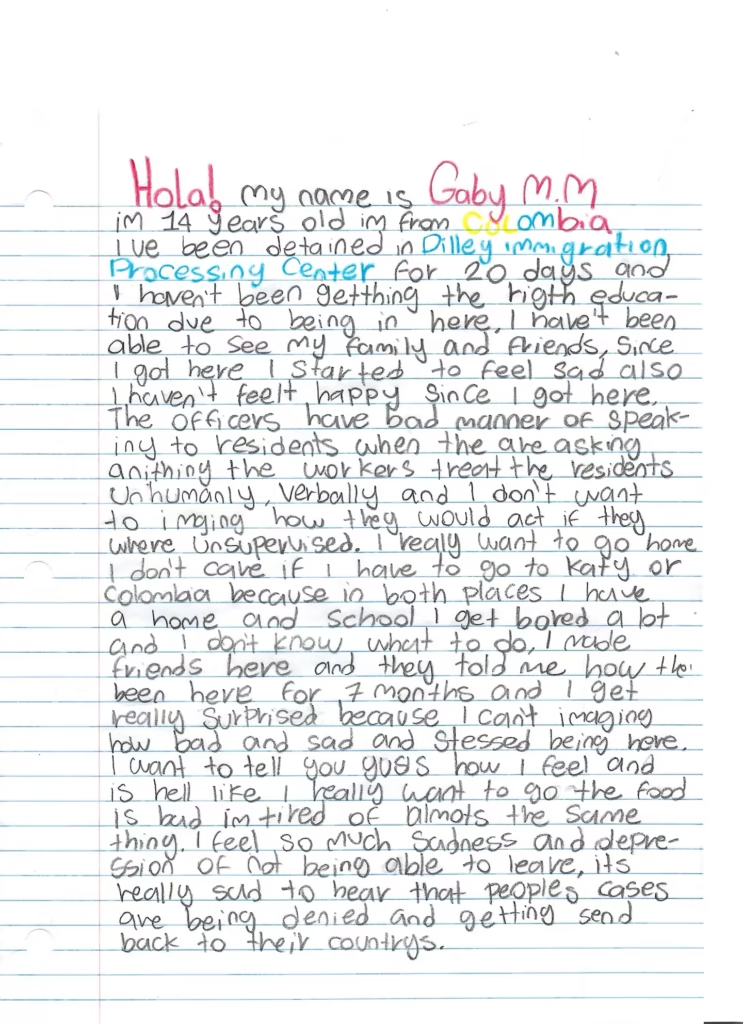
Reports have also emerged from the family detention center in Dilley, Texas, where a measles outbreak was recorded. Children housed there wrote letters describing difficult conditions, accounts that officials at the Department of Homeland Security disputed.
“I’ve been detained for 45 days and I have never felt so much fear to go to a place as I feel here,” a 14-year-old named Ariana wrote. “Since I got to this Center, all you feel is sadness and mostly depression.”
Karen and Bill Newton were released in November, according to The Guardian. Karen received the promised $1,000 payment under the self-removal agreement, while her husband reportedly did not receive compensation.
Since returning home, Karen and other former detainees have warned international travelers to carefully consider trips to the United States during the current administration’s stricter immigration enforcement.
“I worry about young people going out there for the World Cup, I really do,” Rebecca Burke, a British backpacker detained by ICE, told The Guardian. “I imagine a group of young guys getting drunk at a game, getting arrested. I could see them easily ending up in the same place as I did. They’d find some reason to detain them. If it can happen to me, it can happen to anybody.”
Tighter immigration enforcement policies have coincided with a decline in international travel to the United States. Recent industry data showed the country as the only major global destination to record a drop in tourism, contributing to billions of dollars in lost revenue.