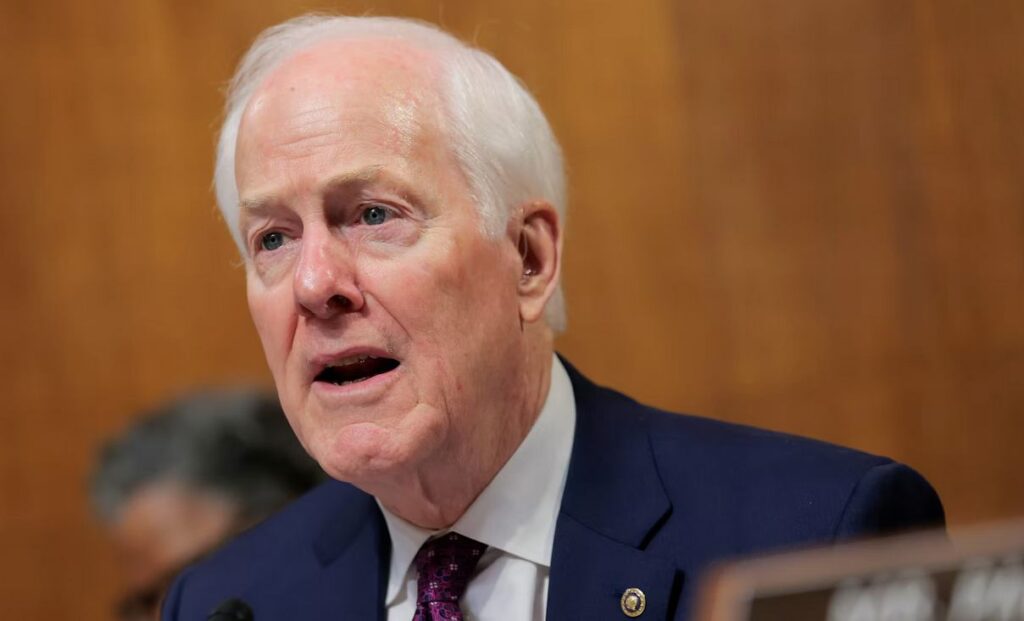
Republican Senator John Cornyn appeared to get a direct explanation this week of why critics say the SAVE Act, strongly backed by President Donald Trump, could end up suppressing millions of votes if it becomes law.
During a Senate Judiciary Committee hearing on Thursday, Cornyn questioned claims that the bill would disenfranchise large numbers of Americans. “I don’t understand how [the SAVE Act] could disenfranchise millions of Americans. Maybe you could explain,” the Texas Republican said.
His Democratic colleague, Senator Dick Durbin of Illinois, responded by outlining what critics say are major barriers built into the proposed voter ID requirements.
After thanking Cornyn for raising the question, Durbin pointed out that the identification requirements outlined in the bill would not be satisfied by a standard driver’s license, but instead would require documentation such as a passport.
“Fifty percent of Americans do not have a passport. Those who want to obtain it so they can vote will pay $186 and wait three or four weeks for that to happen,” Durbin said. “Secondly, you can use a birth certificate, but any person who has changed their name as a result of a marriage … has to find not only their birth certificate but some correction of it to prove that they are eligible to register to vote.
“It’s estimated that 9 percent of the voters in America do not have the identification required by this bill. It means that, ultimately, those people will not be voting. And I think that is the ultimate goal of this administration,” Durbin continued.
Cornyn appeared surprised by the explanation and asked whether those concerns might be addressed through amendments to the legislation. Durbin responded bluntly, “When’s the last time we amended a bill?”
Critics of the SAVE Act argue that the legislation appears structured in a way that would make voting significantly more difficult for certain groups of Americans, particularly lower-income voters who may struggle to obtain expensive identification documents and married women whose names differ from those listed on their birth certificates.
Supporters of voting rights groups also note that documented cases of widespread voter fraud in the United States remain extremely rare, raising questions about whether the proposed restrictions address a real problem.
Sen. CORNYN: I don’t get how the SAVE Act disenfranchises.
— Senate Judiciary Democrats 🇺🇸 (@JudiciaryDems) March 12, 2026
Sen. DURBIN: Happy to explain. Drivers licenses don’t work. 50% of Americans don’t have passports.
Cornyn: Amend it?
Durbin: When’s the last time the Senate amended a bill? pic.twitter.com/hPCogUjOOv
Despite those concerns, the Trump administration has continued to push the measure aggressively. White House press secretary Karoline Leavitt has acknowledged that voters who have changed their names or personal information would need to update their documentation in order to vote.
At the same time, Trump has elevated the SAVE Act as one of his administration’s top political priorities, pressing lawmakers to move the legislation forward even as critics warn it could make voting more complicated for millions of eligible Americans.