
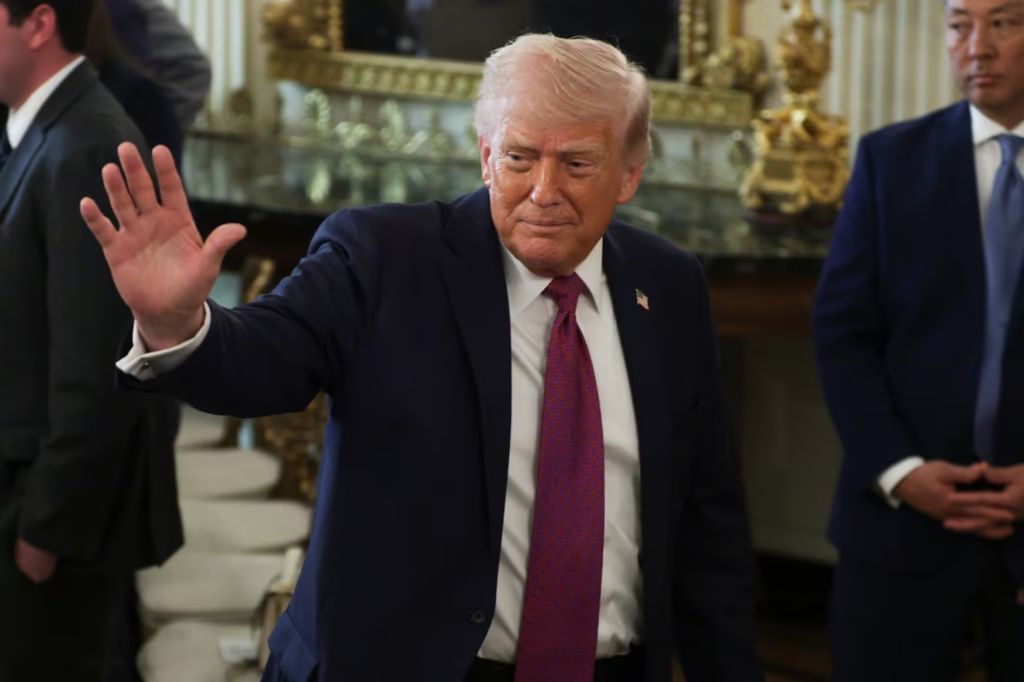
President Donald Trump suggested earlier this week that Venezuela should be annexed by the United States. He reportedly told Fox News correspondent John Roberts—not to be confused with the chief justice—that he was “seriously considering a move to make Venezuela the fifty-first state.”
This is a far-fetched idea, to say the least. Venezuela has no interest in voluntarily becoming a U.S. state, as its acting President Delcy Rodríguez told reporters on Monday. “We will continue to defend our integrity, our sovereignty, our independence, our history,” she said, adding that Venezuela was “not a colony, but a free country.”
U.S. forces managed to infiltrate the country and arrest former President Nicolás Maduro earlier this year, which led to Rodríguez’s interim presidency. Trump suggested in January that the U.S. would play some kind of administrative role over the country after capturing Maduro, but no such direct control appears to exist. Venezuela retains every functional attribute of sovereignty.
I would welcome anyone to join the United States, so long as they do so freely, voluntarily, and democratically, and so long as they agree to live under the Constitution and its principles. I would not support the forcible annexation of any country or territory to the U.S. under any circumstances. If the Trump administration sought to seize any territory by force or coercion, the next Democratic president would be legally and morally obligated to return it to its previous status.
For that reason, it is worth thinking through the legal and constitutional implications of annexing Venezuela, Greenland, or even Canada—especially since they are not favorable to the Trump administration’s other political, social, and cultural priorities. The United States has not annexed a significant portion of foreign territory within living memory. While Alaska and Hawaii were admitted to the Union in 1959, they had already been organized U.S. territories long before statehood.
It is crucial that Trump specified that Venezuela would become the fifty-first state, not an incorporated territory or some insular possession. (He may be unaware of those options.) Some U.S. acquisitions have not resulted in statehood. After the Spanish-American War, for example, the United States took possession of a medley of former Spanish colonies in the Caribbean and the Pacific. None of them have become U.S. states.
The U.S. had no plans to hold Cuba long-term, and the island nation gained formal independence in 1902. The Philippines would only obtain independence in 1946 after decades of colonial rule. Puerto Rico and Guam remain under U.S. control to this day. Though Puerto Rican independence and statehood are often alternatively discussed on the island and in D.C., Congress has taken no steps down either path—and in the case of Puerto Ricans, the matter is the subject of heated internal debate.
Trump’s described outcome—that the Bolivarian Republic of Venezuela immediately becomes a state—most closely resembles that of Texas, whereby a fully independent nation was admitted to the Union without first being a territory. But it is unclear whether Trump has considered the full implications of statehood for Venezuela. The first and most obvious consequence is political representation. The U.S. Census Bureau estimates that roughly 32 million people live in Venezuela, which would make it the second-most-populous state in the Union, behind only California.
For clarity’s sake, let us imagine that Venezuela is formally admitted into the Union on January 1, 2027, by a joint resolution of Congress. At that moment, the U.S. state of Venezuela is instantly eligible for representation in the U.S. Senate. The state government in Caracas could fill these new vacancies through whatever method it prescribes by law until the next election cycle, as authorized by the Seventeenth Amendment.
Venezuelans would not have the chance to vote for both senators automatically in the next election. When Alaska joined the Union in 1959, its two senators-elect flipped a coin to decide who would be the senior senator and who would be the junior senator. Bob Bartlett won the toss and had to run for reelection in 1960, while his colleague Ernest Gruening waited until 1962.
Even this small addition would change some of the basic math of the American legislative process. A happy coincidence of the last 60 years is that the Senate has had exactly 100 members. Two additional members would raise the filibuster threshold, which is pegged to three-fifths of the Senate’s membership, to 61 votes. Sixty-eight senators would also be required to meet the two-thirds threshold for certain votes, like overriding a veto or convicting an impeached official.
What about Venezuela’s representation in the House of Representatives and the Electoral College? That is a trickier question. Every other state automatically obtained its House representation as soon as it was admitted to the Union, which also determined its number of presidential electors. Nevada famously sent its state constitution to D.C. by telegraph—the longest message of its kind at the time—rather than mail so Congress could approve it a few days before the 1864 presidential election.
I mentioned earlier that the Census Bureau estimates that 32 million people live in Venezuela. But that number is only an estimate at best: Venezuela was obviously not part of the 2020 census, and the country does not appear to have conducted its own census since 2011. There is no evidence that Venezuela’s scheduled 2021 census took place, whether due to the pandemic, political instability, or some other reason.
Congress could theoretically legislate that Venezuela would receive a certain number of House seats upon admission until the 2030 census, at which point it would be counted and reapportioned normally. This method was first adopted in 1845 when Congress admitted the Republic of Texas to the Union. Texas had been a short-lived breakaway state from Mexico and conducted no census of its own. Congress instead declared that the state would be admitted “with two representatives in Congress, until the next apportionment of representation.” It received the same number of seats after the 1850 census, so lawmakers had made a pretty good guess.
Suppose that Congress, at Trump’s behest, made a similar guess here. Each House seat currently represents an average of 761,000 people after the 2020 census. As a result, one would expect Venezuela to temporarily receive roughly 42 House seats for the 2028 and 2030 House elections. That would amount to the second-largest delegation in the chamber and be greater than the combined House delegations of Illinois, Ohio, and Indiana. Under the Constitution’s formula for the Electoral College, Venezuela would also receive 44 electoral votes in the 2028 presidential election.
Imagine the political power shift that such a large voting bloc would create in the nation’s capital. The House is already narrowly contested between Democrats and Republicans; those lines are expected to harden by the recent surge in partisan gerrymandering in recent years, and especially during the last two years. Venezuelan House members would effectively decide the passage of most existing legislation. If they sided en masse with one party or another, they would be granting it an extraordinary governing margin. If Venezuelan representatives voted as a national bloc, they would be the decisive factor in nearly every legislative debate.
That power would extend to the executive branch, as well. The state of Venezuela would also be automatically entitled to votes in the Electoral College to choose the next president in the 2028 election. Under the Constitution, each state has a number of electors equal to its representation in the House plus its two senators. With roughly 44 electoral votes up for grabs, how Venezuelans vote could effectively decide Trump’s successor in the White House.
After the 2030 census, Venezuela’s statehood would have dramatic consequences for existing House delegations. The Constitution allows Congress to decide the number of House seats. While Congress used to update that number after almost every census to reflect the nation’s growth, the Apportionment Act of 1929 ultimately capped the House’s size at 435 members.
For the first four years of Venezuelan statehood, the House’s size would temporarily expand to 477 members under the math I outlined above. This would follow the precedent set by the admissions of Alaska and Hawaii in 1959, which expanded the House to a record 437 members until the 1960 census. But unless Congress passed a new Apportionment Act during that span, the House would automatically shrink back to 435 members after the 2030 census.
That shift would shrink each state’s delegation proportionate to Venezuela’s population, even before factoring in the decade-long population shifts between the states. A Republican lawmaker from Texas or Florida who voted to admit Venezuela in 2026 might find themselves without a seat in 2032 without losing a single election. Even Democrats in California and New York would likely find themselves with more representatives than seats.
Of course, it is possible that Trump and his allies would not follow past precedent to the letter. The Constitution does not obligate Congress to provide for House representation for newly admitted states between census counts, even though Congress has invariably done so. But even this would only delay the inevitable. After the 2030 census and the reapportionment that followed, no matter what, the state of Venezuela and its citizens would be entitled to full political representation in the federal government.
I say “citizens” because, if Venezuala were annexed and admitted into the Union, that is what its residents would become: full-fledged citizens of the United States, with all the powers and protections that come with it. In every instance where the U.S. has acquired territory from a sovereign nation, U.S. citizenship has followed it.
In 1819, for example, Spain ceded what is now Florida to the United States in the Adams-Onis Treaty. One of the treaty’s provisions held that the state’s current inhabitants “shall be incorporated in the Union of the United States as soon as may be consistent with the principles of the Federal Constitution, and admitted to the enjoyment of all the privileges, rights, and immunities of the citizens of the United States.”
Florida, however, did not join the Union until 1845. The state’s population remained too low to meet Congress’s usual standards for admission, only crossing the informal 50,000-person threshold after the 1840 census. Sectional disputes over slavery also played a role: Florida’s admission as a slave state was paired with Iowa’s entry as a free state to preserve the antebellum balance of power.
Even before Florida’s formal admission to the Union, however, its Spanish inhabitants had become American citizens. In 1828, the Supreme Court heard a case involving an esoteric admiralty-law dispute from a local court in what was then the Florida Territory. As part of its decision, the justices considered “the relation in which Florida stands to the United States.” Chief Justice John Marshall concluded along the way that Congress could properly naturalize all of Florida’s Spanish inhabitants through the Adams-Onis Treaty.
“This treaty is the law of the land, and admits the inhabitants of Florida to the enjoyment of the privileges, rights, and immunities of the citizens of the United States,” he wrote in American Insurance Company v. Canter. “It is unnecessary to inquire whether this is not their condition independent of stipulation. They do not, however, participate in political power; they do not share in the government till Florida shall become a state.”
Marshall’s caveat that the court need not decide whether they would be citizens “independent of stipulation” is constitutionally interesting. At minimum, the chief justice was suggesting that Spanish Floridians may have automatically become U.S. citizens by virtue of the territory’s acquisition by the United States. In that case, the stipulation merely confirmed for Spain what was already the law of the land, so to speak.
Unless the Supreme Court abrogates birthright citizenship in the next few months in Trump v. Barbara, every child born in the state of Venezuela after January 1, 2027, would instantly become a U.S. citizen upon birth. I would argue that the existing citizens of any country annexed by the United States automatically become U.S. citizens, as well, under the Fourteenth Amendment’s citizenship clause.
That reading would reflect the settled practice of the U.S. government before the amendment’s ratification. The Treaty of Guadeloupe Hidalgo, which transferred most of what is now the Western United States from Mexico to the U.S. government in 1848, set a one-year deadline for inhabitants of the newly acquired lands to choose whether to stay or leave. As a fail-safe, it declared that anyone who stayed in the newly acquired lands “without having declared their intention to retain the character of Mexicans, shall be considered to have elected to become citizens of the United States.”
When the United States purchased Alaska from the Russian Empire in 1867, the treaty ratified by the Senate declared that the “inhabitants of the ceded territory” were free to return to Russia within three years. Those who stayed, aside from the Alaska Natives, “shall be admitted to the enjoyment of all the rights, advantages, and immunities of citizens of the United States, and shall be maintained and protected in the free enjoyment of their liberty, property, and religion.” (Alaska Natives later received U.S. citizenship through the Indian Citizenship Act of 1924.)
Extending U.S. citizenship to Venezuelans would have profound implications for the national budget, for programs like Social Security and Medicare, and for every program that distributes funds through state governments. I could not even begin to calculate the fiscal impact. About 770,000 Venezuelan citizens already live in the U.S., according to a 2023 report, though that number may have changed since then thanks to the Trump administration’s immigration policies.
The irony of all of this annexation talk is that the Trump administration has gone to great lengths to remove Venezuelan immigrants from U.S. soil. Last year, it even invoked the Alien Enemies Act to accelerate the deportation process for tens of thousands of Venezuelan nationals inside the U.S. Trump and his top officials have sought to reduce the U.S. immigrant population through mass deportations and aggressive campaigns to deter migration. Their all but stated goal is to substantially reduce the number of nonwhite Americans in the United States.
Trump’s proposal to annex Venezuela and admit it into the Union would run counter to this policy program, to say the least. Though its people would not technically be “immigrants,” Venezuelan statehood would dwarf any previous immigration flow into the United States, creating upward of 33 million new U.S. citizens in a single move. For that reason, it is worth treating Trump’s “fifty-first state” suggestions as unlikely to happen—even if it is fun to imagine how much Stephen Miller would hate it.