
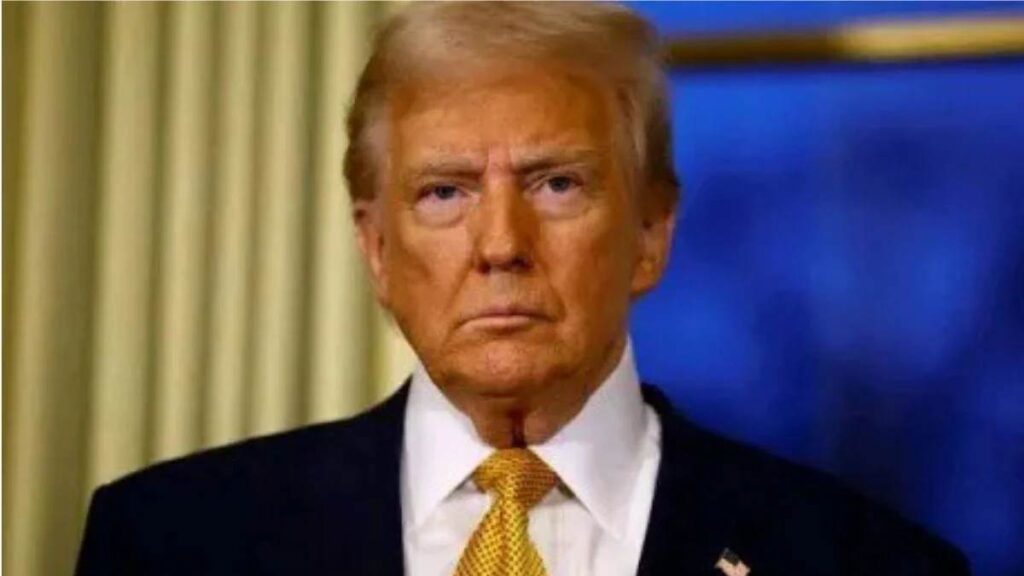
President Donald Trump went completely off script during what was supposed to be a routine congratulatory call with four NASA Artemis II astronauts on Monday, April 6. What began as a moment of national pride quickly turned into something far more personal. The 79-year-old president admitted, live and unfiltered, that he may not survive long enough to witness the space vision he is fighting so hard to build.
Trump placed the call to the crew aboard the Orion spacecraft as they completed a historic six-hour lunar flyby around the far side of the Moon as part of the Artemis II mission. The crew, Commander Reid Wiseman, pilot Victor Glover, and astronauts Christina Koch and Jeremy Hansen, had just set a record for the farthest distance ever traveled by humans from Earth. It was a moment that deserved grace, clarity, and presidential weight.
Trump delivered something entirely different.
The approximately 13-minute call featured long stretches of silence, repeated mentions of Trump’s friendship with retired hockey legend Wayne Gretzky, and a claim that he had personally saved NASA from being shut down. At one point, the silence lasted 63 full seconds. Astronaut Commander Reid Wiseman eventually grabbed the floating microphone and asked NASA Administrator Jared Isaacman to confirm whether the president was still on the line.
“I am, yes, I am,” Trump replied.
But the moment that truly caught America off guard came when Trump began speaking about his vision for the Moon and Mars. He described planting flags, building permanent lunar bases, and eventually pushing toward the red surface of Mars. Then, almost without warning, he turned inward.
“I’d love to be here, but maybe we won’t make it in terms of timing,” Trump said quietly during the live NASA call.
It was a rare, unscripted admission from a man who rarely shows vulnerability in public. The president appeared to genuinely question, out loud, whether he would still be alive by the time America reaches Mars. For a brief moment, the bravado faded, and what remained was simply an old man staring into the vast silence of space, wondering if he would live to see the finish line.
The irony was not lost on many observers. While Trump spoke passionately about America’s future in space, his own administration had proposed a 23% cut to NASA’s budget just days earlier, on April 3, only two days after Artemis II launched. That proposed cut, which would have brought NASA’s funding to its lowest point in a decade, was met with fierce opposition from both Democrats and Republicans in Congress.
NASA Administrator Jared Isaacman, a Trump ally, addressed the contradiction with carefully chosen words. “I strongly support the president’s fiscal policies,” Isaacman said, while quietly urging NASA workers to “leave the politics for the politicians and remain focused on the mission.”
Despite the budget tensions, NASA reaffirmed its commitment to Trump’s lunar ambitions in a statement issued on March 24. “NASA is committed to achieving the near-impossible once again, to return to the Moon before the end of President Trump’s term, build a Moon base, establish an enduring presence, and do the other things needed to ensure American leadership in space,” Isaacman stated.
The agency confirmed that another Artemis mission is planned for 2027, with at least one lunar surface landing targeted every year after that. A permanent lunar outpost is expected to have its initial elements in place by 2030.
Trump also referenced an executive order he signed in mid-December, directing the United States to pursue absolute space superiority. The order outlined a sweeping national space policy aimed at extending human discovery, securing economic and security interests, and laying the groundwork for a new space age.
The Artemis II crew, for their part, remained gracious throughout. Pilot Victor Glover thanked the president warmly, calling the experience “the thrill and honor of a lifetime.” Trump closed the call by inviting all four astronauts to the Oval Office and joking that he would ask for their autographs.
What lingered long after the call ended, however, was not the politics, the budget fights, or even the awkward silence. It was those few quiet words from a president who, for just one unguarded moment, seemed to understand that the stars he is pointing toward may belong to someone else’s tomorrow.


Toll geschrieben und sehr motivierend