
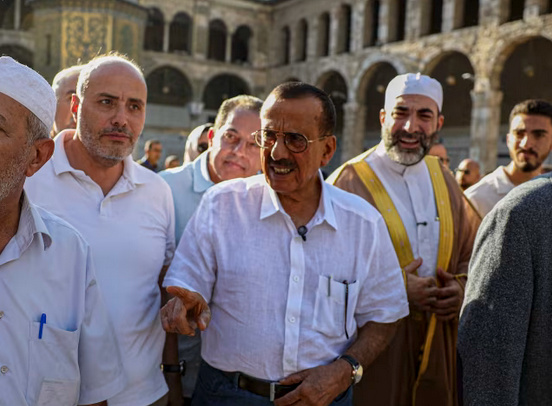
A financial partnership that once appeared to be a cornerstone of President Donald Trump’s foreign economic strategy is now facing growing uncertainty as tensions in the Middle East deepen. Over the past year, some of the wealthiest countries in the Persian Gulf pledged trillions of dollars in potential investments into the United States.
Those commitments from Saudi Arabia, the United Arab Emirates, and Qatar were widely presented by the Trump administration as proof that America remained the most attractive destination for global capital. But as conflict involving Iran intensifies following U.S. military action, analysts warn that the economic and political foundations of that partnership are beginning to show strain.
Rare public criticism from Gulf elite
The first signs of unease are now emerging from within the Gulf itself. Khalaf Al Habtoor, a prominent Dubai billionaire and chairman of the Al Habtoor Group, openly criticized Trump’s decision to escalate military action in the region. “Who gave you the authority to drag our region into a war?” Al Habtoor wrote in a post on X on Thursday, adding that the president had placed the Gulf states “at the heart of a danger they did not choose.” His comments are notable because public criticism of American leadership from influential Gulf business figures remains rare.
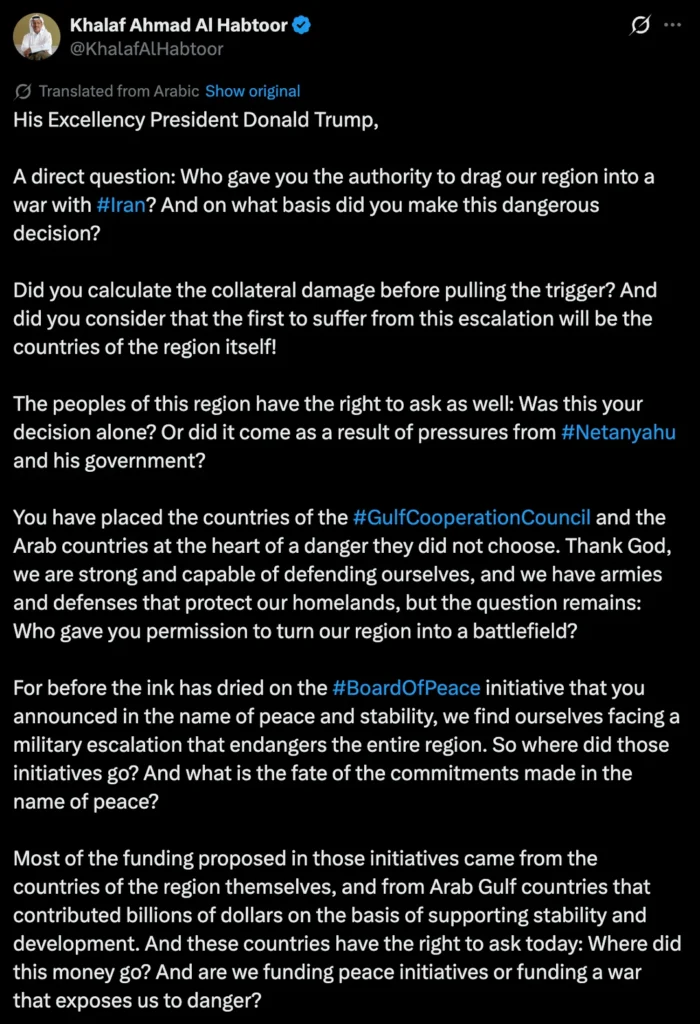
Al Habtoor built his conglomerate from a small engineering firm founded in 1970 into a multinational enterprise spanning hotels, automotive businesses and publishing, and his remarks reflect a broader anxiety spreading across parts of the Gulf establishment that the region is being drawn into a conflict that threatens both economic stability and domestic political balance.
A $3 trillion economic partnership under pressure
Before tensions escalated, the Gulf monarchies had pledged more than $3 trillion in investment commitments to the United States, with Trump frequently highlighting those promises as evidence that his policies were attracting unprecedented foreign capital. Gulf sovereign wealth funds were increasingly involved in projects ranging from artificial intelligence development to infrastructure and reconstruction plans tied to U.S. strategic priorities. Yet analysts now say the conflict could reshape the willingness and ability of those states to maintain such commitments.
Rachel Ziemba, an adjunct senior fellow at the Center for a New American Security, warned that the crisis introduces serious uncertainty into the financial relationship, saying the conflict raises new questions about the Gulf countries’ capability and interest in investing in the U.S. A prolonged confrontation could force Gulf governments to redirect financial resources inward as declining energy revenues, rising defense spending and disruptions to shipping routes and tourism begin placing pressure on regional economies.
Domestic pressure growing inside Gulf societies
Beyond financial calculations, political dynamics inside Gulf countries may become equally important. Many of these states host large Muslim populations closely watching the role played by the United States and Israel in the widening conflict. Diplomats and analysts note that frustration toward U.S. military actions is growing among segments of the public in the region as tensions escalate.
While Gulf governments maintain tight control over political expression, leaders in Riyadh, Abu Dhabi, and Doha must still manage public sentiment carefully. Rapidly growing anger toward U.S. policies among Muslim communities inside these countries could force Arab leaders to distance themselves from Washington if the perception spreads that American actions are primarily aimed at protecting Israeli strategic interests while exposing Gulf states to regional instability.
The economic stakes are enormous
The financial implications of any shift are substantial. Sovereign wealth funds across the Gulf collectively control more than $2 trillion invested in U.S. markets, meaning even a partial withdrawal could create turbulence across major sectors of the American economy.
Research firm Capital Economics has already begun adjusting forecasts, warning that economic growth in the Gulf region could fall by up to one percentage point if the conflict continues for several weeks. In addition to weaker energy revenues, disruptions to shipping lanes and declining tourism are adding pressure on government budgets. Under these circumstances, reducing foreign investments could become a financial necessity rather than a purely political signal.
Trump’s Gulf strategy faces new uncertainty
The situation contrasts sharply with the optimism surrounding Trump’s relationship with Gulf monarchies only a year ago. Shortly after returning to the White House, Trump made the region the destination of his first major foreign trip in spring 2025, where lavish ceremonies and major investment announcements highlighted the growing economic partnership. Plans soon followed for projects including a Disneyland theme park in Abu Dhabi, while Qatar pledged the donation of a jumbo jet.
Trump’s business network and associates also expanded commercial ventures in the region, pursuing cryptocurrency and private equity deals while planning Trump-branded residential towers and golf developments in Dubai, Jeddah, and Riyadh. Meanwhile Gulf sovereign wealth funds continued making major global acquisitions, including the Saudi-backed $55 billion buyout of videogame developer Electronic Arts and an Abu Dhabi fund’s acquisition of Clear Channel Outdoor Holdings, while also backing Paramount Skydance’s attempt to acquire Warner Bros. Discovery. At the U.S.-Saudi Investment Forum in Washington, Trump appeared alongside Saudi Crown Prince Mohammed bin Salman, praising what he described as a strong economic alliance.
A delicate balance between strategy and stability
The White House has defended the strikes against Iran as necessary to protect American interests and regional commerce. “State-sponsored Iranian terrorism didn’t just harm America and Americans, but our allies—including other Gulf nations,” a White House spokesman said, adding that the operation “only safeguards regional stability and commerce in the region.”
However, critics argue that escalating the conflict risks drawing Gulf states into a confrontation they had sought to avoid, one that could destabilize their economies and inflame public opinion across the region. Some investors remain optimistic that the crisis will calm. Jon Gray, president of Blackstone, said in a CNBC interview that he believes the conflict will ultimately be resolved and that the U.S. and its allies will emerge victorious. Yet economists warn that if Gulf leaders begin distancing themselves financially or politically from Washington, the consequences could ripple across global markets — from the Middle East to Wall Street — reshaping one of the most important economic partnerships of the past decade.