

Nine months into Donald Trump’s presidency, during which he promised to cut prices “from day one,” a large majority of Americans report that their monthly expenses have risen by between $100 and $749, according to a new exclusive poll conducted for the Guardian.
Trump has repeatedly claimed that there is “virtually no inflation.” “Prices are ‘WAY DOWN’ in the USA,” he wrote on social media in late August. Yet the new Harris poll shows that Americans continue to face rising costs and growing pessimism about the economy.
When asked to estimate how much their regular monthly household costs have increased compared with last year, 74% of respondents said they had experienced increases of at least $100, the poll found. The price hikes were reported across the political spectrum, with Democrats, Republicans, and independents alike noting higher costs.
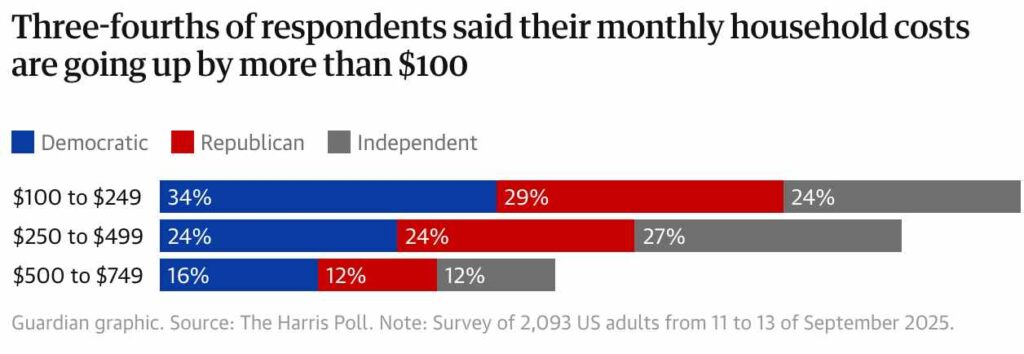
Trump’s re-election came amid voter dissatisfaction with Joe Biden’s economic record and the legacy of Covid-era inflation. “Starting on day one, we will end inflation and make America affordable again,” Trump said during a rally in August 2024.
The annual inflation rate has declined from 3% in January, when Trump took office, to 2.9% in August, the latest published figures show. While well below the peak of over 9% in 2022, the rate remains above the Federal Reserve’s 2% target.
The poll’s results are consistent with research from the Yale Budget Lab, which calculated that households face an average $2,300 increase in yearly costs due to Trump-era tariffs – roughly $191 per month. The research accounts for overall price increases and their impact on average household income.
Many viewed the 2024 presidential election as a referendum on Biden’s economy. Inflation surged after the pandemic while wages lagged, leaving many Americans feeling their paychecks lost value. While Democratic candidate Kamala Harris presented an economic plan focused on costs, many voters saw it as too late to make a difference.
However, just over a year before the midterms, the economic outlook under Trump does not appear much brighter. A slight majority of Americans (54%) said they believed the economy is in a recession, five points higher than in Harris’s Guardian poll last September. Similarly, 53% think the economy is worsening, compared with 48% a year ago.
When asked which issue posed the biggest risk to the U.S. economy, respondents ranked inflation highest, above immigration, U.S. democracy, and tariffs. Inflation topped the list for Republicans (31%) and independents (33%), while it was the second biggest risk for Democrats (29%), behind tariffs.

The parties diverge on other threats. Immigration was the second biggest concern for Republicans, with 20% citing it, compared with just 8% of Democrats and independents. Tariffs were a major concern for Democrats (31%) and independents (24%).
Regarding the causes of price increases, 45% of Republicans said they were standard yearly changes due to inflation, versus 22% of Democrats and 27% of independents. Meanwhile, 55% of Democrats and independents attributed rising prices to government economic policies. Slightly over 20% across all political groups said businesses overcharging customers were to blame.
While Republicans were less likely than Democrats to blame tariffs and Trump administration policies, independents were just as likely as Democrats to cite tariffs as a factor. This marks a notable shift from last year, when independents were more aligned with Republicans on economic pessimism, which may have contributed to votes for Trump in 2024. Though independents were split between Trump and Biden, they had favored Biden by 9% in 2020, according to Pew Research Center.
Despite declining Democratic support, economic policies promoted by Democrats, including a federal ban on price gouging for food, expansion of the child tax credit, and higher taxes on long-term capital gains for millionaires, remain popular and more widely supported than Trump’s policies. Support for these Democratic policies mirrors results seen last September.
The ban on price gouging, proposed by Harris’s campaign, was the most popular policy, with 45% saying it would strengthen the economy. Trump’s highest-supported policy, eliminating taxes on Social Security, received 43% support but has yet to be implemented.
By contrast, some core Trump administration policies were among the least popular: mass deportation of migrants (24%), tax cuts (22%), and tariffs on foreign goods (22%).